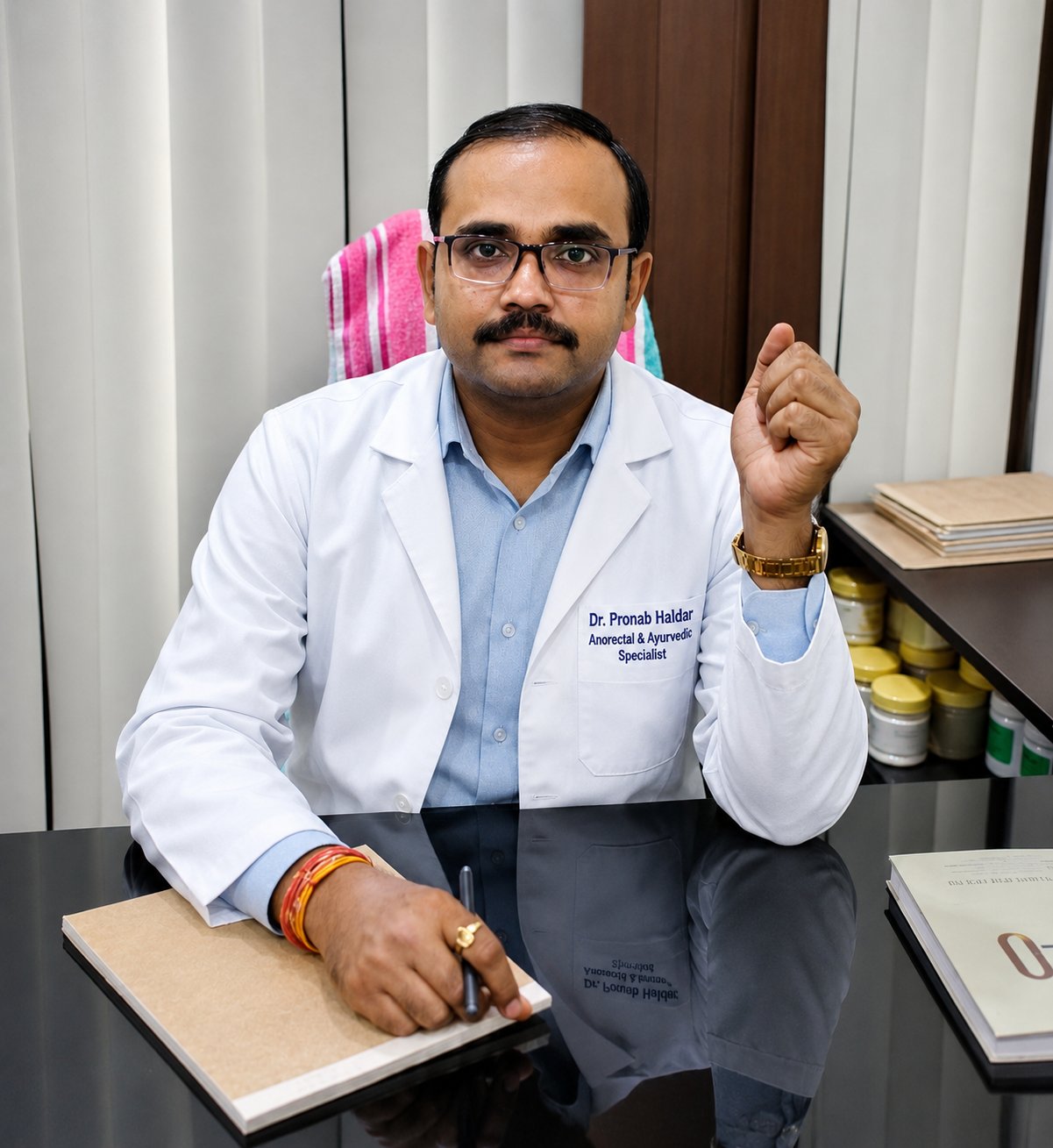
People search for this condition in many ways — bawaseer, bawasir, babasir, bavasir, bawaseer in English, piles meaning in Hindi. All of them refer to the same problem. In Ayurveda, piles are called Arsha (अर्श), and Dr. Pronab Haldar treats them with Ayurvedic medicines and, where needed, the Ksharsutra / Ksharkarma method.
| Common word | English / medical name | What it means |
|---|---|---|
| Bawaseer / Bawasir (बवासीर) | Piles / Haemorrhoids | Swollen veins at the anus or lower rectum |
| Khooni bawaseer (खूनी बवासीर) | Bleeding piles (usually internal) | Bright red blood with or after stool |
| Badi / baadi bawaseer (बादी बवासीर) | Non-bleeding or external piles | Painful lump, itching, swelling outside the anus |
| Masse (मस्से) | Pile mass / prolapsed haemorrhoid | Lump that comes out during stool |
| Bhagandar (भगंदर) | Anal fistula | Tunnel near the anus with pus discharge — not piles |
| Fissure / parikartika (परिकर्तिका) | Anal fissure | Cut or tear in the anus causing sharp pain — not piles |
| Arsha (अर्श) | Ayurvedic name for piles | Used in Ayurvedic texts and treatment |
These form inside the rectum. They usually do not hurt but can cause painless bright red bleeding. Doctors grade them from 1 to 4:
| Grade | What happens | Usual approach |
|---|---|---|
| Grade 1 | Bleeding only, no lump comes out | Diet, fibre, Ayurvedic medicines |
| Grade 2 | Lump comes out during stool and goes back by itself | Medicines + Ksharkarma / Ksharsutra if needed |
| Grade 3 | Lump comes out and has to be pushed back by hand | Ksharsutra / Ksharkarma usually advised |
| Grade 4 | Lump stays outside and cannot be pushed back | Needs procedure — do not delay |
These form under the skin around the anus. They can itch, swell and become very painful if a clot forms inside (thrombosed pile).
Rectal bleeding is most often due to piles or fissure, but it should always be examined by a doctor once — other causes such as polyps must be ruled out. Read more on blood in stool.
See the full guide on causes and risk factors of piles.
Treatment depends on the type and grade. Most early piles settle with diet change and medicines. Advanced, prolapsing or repeatedly bleeding piles need a procedure.
| Option | Best for | Points to know |
|---|---|---|
| Diet, fibre, water, sitz bath | Grade 1, mild symptoms | Foundation of every treatment; prevents recurrence |
| Ayurvedic medicines | Grade 1–2, bleeding, itching | Improve digestion and bowel habit, reduce bleeding |
| Ksharsutra / Ksharkarma | Grade 2–4, recurrent piles | Day-care Ayurvedic para-surgical method; no major cutting; most people resume work quickly |
| Laser / stapler / open surgery | Selected advanced cases | Needs OT and anaesthesia; recurrence is possible — read laser vs Ksharsutra |
Dr. Pronab Haldar (B.A.M.S., MD, PhD — Ayurveda) has treated piles, fistula and fissure in Indore for 18+ years at Dr. Haldar's Piles Clinic, Capital Tower, Sapna Sangeeta Road. Patients also visit from Ujjain, Dewas, Dhar, Mhow, Khandwa and Khargone. Call +91 63720 62915 or WhatsApp +91 96912 41120.
Bawaseer is called piles in English. The medical term is haemorrhoids (US spelling: hemorrhoids).
Khooni bawaseer means bleeding piles — usually internal haemorrhoids that cause bright red bleeding with stool.
No. Bawaseer is piles (swollen veins). Fistula (bhagandar) is an abnormal tunnel near the anus that discharges pus. They need different treatment.
Early piles usually settle with diet and medicines. Many grade 2–3 piles are treated with Ayurvedic Ksharkarma / Ksharsutra as a day-care procedure without major surgery. A doctor must examine you to decide.
Piles are usually not dangerous, but heavy bleeding can cause anaemia, and bleeding can also come from other conditions. Get examined once instead of self-treating for months.